Milk may not be a great movie, but it comes at the right moment, and it turns out to be irresistibly moving. Although it’s a fairly standard biopic, it’s directed with finesse by Gus Van Sant and beautifully acted by an excellent ensemble cast. Would it have had the same impact if it opened at a different time? Probably not. But as Californians are reeling from the passage of Proposition 8, the anti-gay marriage initiative, the movie’s evocation of an earlier seminal moment in the gay rights movement strikes a nerve. Milk devotes a lot of attention to the battle over Proposition 6 in 1978, the Briggs initiative that sought to ban gay teachers from public schools, and that campaign prefigured the current storm over gay marriage. The massive candlelight vigil that ends the film serves as a stirring testament to the ongoing struggle for equality and dignity.
Hollywood loves to congratulate itself on being in the vanguard of social issues, but in truth, moviemakers are inevitably a little behind the times. Brokeback Mountain scored an enormous critical and commercial success three years ago, but when the Academy had a chance to honor the film, it got cold feet and went for the mediocre Crash instead. Will Milk win the Oscar that should have gone to Brokeback? It’s possible, and it wouldn’t be the first time that Hollywood belatedly tried to make amends for a previous snub. (Paul Newman didn’t win the Oscar for The Hustler or Hud or Cool Hand Luke, but for the forgettable The Color of Money.)
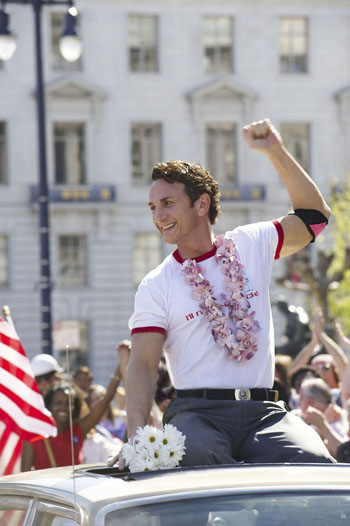
As a piece of filmmaking, Milk is inferior to Brokeback, and it doesn’t have a character as richly complex as Heath Ledger’s Ennis Del Mar. Harvey Milk is portrayed as a born schmoozer who wasn’t as adroit in his personal relationships as in his political manipulations. But the competent script by Dustin Lance Black doesn’t cut very deep in its depiction of Milk. What’s missing from the script is luckily provided by Sean Penn’s superlative performance. This performance is a real surprise. It’s unlike anything Penn has done before, though maybe it harks back to his charming performances in such very early films as Taps and Racing for the Moon. The glum intensity that’s marked—and sometimes marred—his recent performance is missing here; it’s almost as if we’re seeing a brand new actor. Penn’s Milk is easygoing, relaxed, and enormously likable. The way he courts potential tricks is the same way he courts voters: he’s up-front and forward but shamelessly endearing.
That charm is visible in many of the supporting performances as well. Emile Hirsch is also completely different from the way he appeared in Penn’s Into the Wild; here he’s a good-hearted, fey sprite. James Franco lends gravity and depth to the role of Milk’s first love, while Diego Luna captures the dangerous instability of a later lover. Josh Brolin brings complexity and even a measure of sympathy to his portrayal of Milk’s assassin, the tortured Dan White.
The film cleverly interweaves newsreel footage from the era, including considerable footage of the gay movement’s nemesis, Anita Bryant. The beautifully staged finale, which incorporates actual film from 1978, packs an emotional wallop. If Milk lacks piercing insight, it compensates with plenty of heart. The picture pays welcome tribute to a pioneer who fought battles that still need to be won.