



Philippe Falardeau’s Monsieur Lazhar deserved its nomination for best foreign language film of 2011. This nearly perfect gem begins as a tiny slice of life, but it sneaks up on you and packs a wallop by the time it reaches its conclusion. The film has already opened to good business in Canada, and it seems likely that word of mouth will propel it here as well when it opens across the country this month.
The film opens with a quietly shocking image. A young boy is bringing a supply of milk to his elementary school classroom when he is startled by what he sees in the doorway: His beloved teacher has hanged herself right in the empty classroom. The repercussions of this act spread and deepen throughout the rest of the film. School authorities bring in a psychologist to help the children deal with this trauma, and things seem to be headed in the right direction when a new teacher from Algeria, Bachir Lazhar (Fellag), offers to take over the class. Although the principal knows little about him, she is desperate to provide some continuity in the middle of the school year. It turns out that Bachir has survived a trauma of his own in his native Algeria. As secrets are gradually revealed during the course of the next 90 minutes, the new teacher and his charges help each other to heal.
While the pacing in the first half of the movie may be overly deliberate, Falardeau wants the emotions that the story generates to be earned, and that’s why he eschews showy theatrics. The film respects the unpredictability and stubbornness of grief, a most unusual subject for a movie about an inspiring teacher. Bachir’s main contribution to the classroom is in encouraging the young students to confront the teacher’s death, which the school administrators would prefer to slip under the rug. The film provides only a few hints as to what led the woman to kill herself, though the focus is not on her but on the bafflement shared by the survivors.
This has been a season with a number of child actors featured prominently in films such as Hugo, Extremely Loud and Incredibly Close, and We Bought a Zoo. Good as some of those child actors are, none of them surpasses the performances that Falardeau has drawn from Sophie Nelisse and Emilien Neron as the two students who were closest to the dead teacher. They both seem impassive at first, but as the pain they feel slowly bubbles to the surface, the film achieves scalding power. The scene in which young Neron finally breaks down as he reveals the irrational guilt he harbors over his teacher’s suicide is as devastating a piece of acting as anything seen this year.
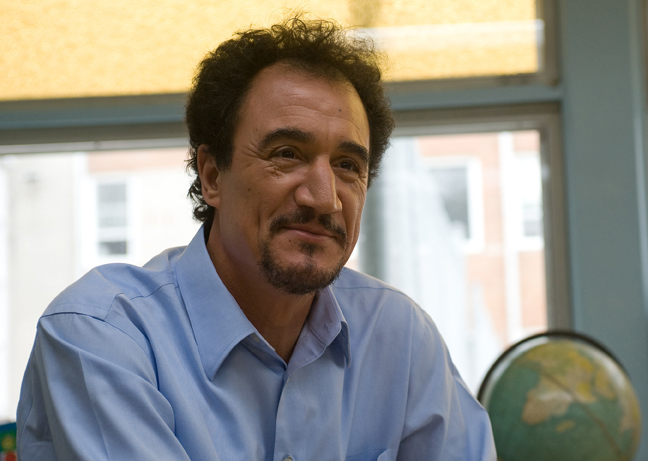
Fellag carries the movie. His jaunty confidence in the classroom masks some inner turmoil that he is fighting to conceal, and the actor’s understated, expressive performance keeps us mesmerized. One scene in particular demonstrates the artfulness of both actor and director. Bachir has been invited to dinner by the school’s attractive drama teacher (Brigitte Poupart), and they have spent a pleasant evening drinking and sharing pleasantries. But as he leaves her apartment, he suddenly stops on the stairway and has a silent breakdown. We sense that this evening of comradeship has stirred memories of his dead wife; Fellag’s face tells of a loss that may never be overcome.
Although the film hews closely to the specific details of this tale, it implicitly raises a host of larger issues: the tremendous responsibility that teachers bear toward their students, the blindness of parents who have no idea of what transpires away from home, the questionable new codes of conduct that forbid any physical contact between teachers and pupils, and finally the disruptions of a world where political upheavals can insinuate themselves into everyday life a continent away. These are ambitious themes for a 90-minute movie to cover, but Falardeau’s economical style and the eloquence of the performances put Hollywood’s bloated epics to shame.