
CINEMA ’62
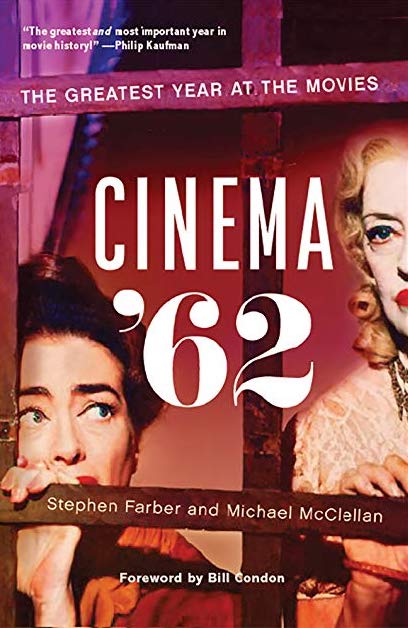
Celebrate CINEMA ’62 at the Billy Wilder Theatre at the Hammer Museum in Westwood on Friday, January 27, 2023! Stephen Farber and Michael McClellan will be discussing and signing their highly acclaimed book. The evening will also include a double feature of two of the lesser known but most provocative movies released in 1962: WAR HUNT, a prescient anti-war drama set during the Korean War, featuring Robert Redford in his big-screen debut, John Saxon as a psychotic soldier, and Sydney Pollack, who moved behind the camera a few years later; and Sam Peckinpah’s early Western, RIDE THE HIGH COUNTRY, featuring Joel McCrea and Randolph Scott as aging cowpokes trying to retain their integrity at the dawn of the 20th century, and newcomer Mariette Hartley in her very first film.
Most conventional film histories dismiss the early 1960s as a pallid era, a downtime between the heights of the classic studio system and the rise of New Hollywood directors like Scorsese and Altman in the 1970s. It seemed to be a moment when the movie industry was floundering as the popularity of television caused a downturn in cinema attendance. Cinema ’62 challenges these assumptions by making the bold claim that 1962 was a peak year for film, with a high standard of quality that has not been equaled since.
Stephen Farber and Michael McClellan show how 1962 saw great late-period work by classic Hollywood directors like John Ford, Howard Hawks, and John Huston, as well as stars like Bette Davis, James Stewart, Katharine Hepburn, and Barbara Stanwyck. Yet it was also a seminal year for talented young directors like Sidney Lumet, Sam Peckinpah, and Stanley Kubrick, not to mention rising stars like Warren Beatty, Jane Fonda, Robert Redford, Peter O’Toole, and Omar Sharif. Above all, 1962—the year of To Kill a Mockingbird and The Manchurian Candidate—gave cinema attendees the kinds of adult, artistic, and uncompromising visions they would never see on television, including classics from Fellini, Bergman, and Kurosawa. Culminating in an analysis of the year’s Best Picture winner and top-grossing film, Lawrence of Arabia, and the factors that made that magnificent epic possible, Cinema ’62 makes a strong case that the movies peaked in the Kennedy era.
Consider some of the other great movies from ’62: The Miracle Worker, Jules and Jim, Days of Wine and Roses, The Man Who Shot Liberty Valance, Divorce Italian Style, Lolita, and Ride the High Country. Read all about them!
Click here to visit the Cinema ’62 page at Rutgers University Press.
Also visit Michael McClellan’s website, www.mrmcclellan.com.
Books are available at Amazon, or through Rutgers University website, www.rutgersuniversitypress.org.
Selected Reviews:
“I wouldn’t have pointed to 1962 as a landmark year for movies, but Stephen Farber and Michael McClellan have proven me wrong. Their knowledgeable and persuasive book spotlights diverse films from the U.S. and abroad that put today’s mainstream releases to shame. Can you imagine a menu of superior movies like Lolita, The Manchurian Candidate, Ride the High Country, Days of Wine and Roses and The Music Man all coming out in one twelve-month period? The authors provide valuable context for this lineup, a treasure trove well worth celebrating.”
(Leonard Maltin film critic and historian)
(Philip Kaufman award-winning director of The Right Stuff and Invasion of the Body Snatchers)
(Penelope Spheeris Director of The Decline of Western Civilization and Wayne’s World)
(Charles Busch playwright, actor and screenwriter)
(W.K. Stratton author of The Wild Bunch)