






Julie Delpy accepting her award in San Sebastian
The San Sebastian Film Festival offers great programs, along with a spectacular seaside location and irresistible Basque cooking. This year’s edition featured first and foremost an exceptional lineup of films. These were a few of my favorites:
Julie Delpy’s Le Skylab, which won a special jury prize from the panel that included actresses Frances McDormand, Sophie Okonedo, and Bai Ling, is one of the most sheerly enjoyable comedies that I’ve seen in recent years. As yet it has no American distribution, but someone should snap it up soon. The film is told from the point of view of a woman recalling a memorable childhood journey. The year is 1979, when Skylab is falling from its perch in outer space and threatens to wreak havoc when it re-enters the earth’s atmosphere. Albertine (Lou Alvarez) is 11 years old and traveling with her parents (played by Delpy and Eric Elmosnino) to a family reunion in Brittany. Most of the movie takes place over a 48-hour period when a large extended family gathers at the bucolic farm to celebrate their grandmother’s birthday. Like Delpy’s other films, this one is semi-autobiographical, but it’s so sharply written and superbly performed that it never seems self-indulgent. Anyone who’s participated in raucous family gatherings will understand this turbulent conclave. Albertine’s parents are leftwing bohemians, whereas some of her father’s siblings are rightwing brutes harboring racist attitudes left over from the Algerian War of the 1960s. Delpy manages to find the humanity and individuality of all the characters, including a bunch of children and adolescents who have their own adventures while the adults are bickering and gorging themselves on a barbecue of roast lamb. (One wry shot of a bunch of sheep watching as a member of their species is roasted on a spit is alone worth the price of admission.) Witty details abound, and all of the actors—including Delpy’s father, Albert Delpy, as a senile uncle, and veteran French actresses Bernadette Lafont and Emanuelle Riva as the two family matriarchs—get a chance to shine. The entire film is a delectable diversion peppered with stinging moments of realistic family conflict.
Sarah Polley’s second film as director, Take This Waltz, proved to be a surprisingly evocative and effective romantic drama. The story could not be more banal. A happily married woman (Michelle Williams) meets an intriguing stranger on a plane. He happens to live in her neighborhood, and as their paths cross more frequently, she finds herself increasingly dissatisfied with her marriage and drawn to this new man on the block. What elevates this ho-hum plot is the consistently acute observation that Polley brings to her heroine’s romantic dilemma. The three lead performances also help to explode any clichés. Williams does some of her finest work to date, capturing every minute flicker of doubt and desire that crosses Margot’s face. In a revelatory performance, Seth Rogen underplays, capturing the husband’s irritating self-absorption as well as his poignant vulnerability when he realizes that his cozy world is about to collapse. As his sister, a recovering alcoholic, Sarah Silverman brings a burst of energy to the picture. And Luke Kirby conveys just the right note of sexual danger as Daniel, the tempting object of desire across the street. One scene in which he describes how he intends to ravish Margot is one of the most erotic scenes in recent movies, even though not a smidgen of flesh is actually shown. In fact, this is a rare movie about infidelity that suggests romantic fantasy can be just as threatening as an affair that is actually consummated. Or is it consummated? The film concludes with a daring, dreamlike sequence in which Margot imagines her new life with Daniel, but we can’t be sure how many of the images we see are actually taking place. Polley allows viewers to come to their own conclusions about the heroine’s fate while suggesting that dissatisfactions will plague her no matter which course she decides to follow.
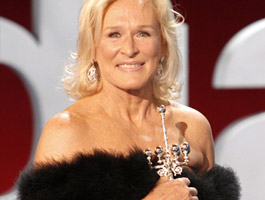
Glenn Close in San Sebastian
Albert Nobbs was something of a labor of love for Glenn Close. She starred in the play almost 30 years ago and has been fighting to make a film of it since then. (She served as co-writer and producer as well as star of the film.) Set in 19th century Ireland, the film focuses on a woman posing as a man at the hotel where she works. Opportunities for women are limited, and “Albert” dreams of saving money in order to open her own shop, an option that is only open to men. Close gives a remarkably subtle transgender performance that always highlights the humanity of this nervous but hopeful character. Director Rodrigo Garcia (Nine Lives, Mother and Child) works with eloquence and restraint in dramatizing this story, and he has assembled a remarkable cast to surround Close. Mia Wasikowska, Aaron Johnson, Pauline Collins, and Brendan Gleeson all give sterling performances. But the movie is stolen by Janet McTeer, who’s been absent from movie screens for the last few years. Playing another woman with a secret life, the statuesque McTeer strides through the movie with panache, and she thankfully provides this sad tale with the slight hint of a happy ending.
Rampart is sure to be a more controversial movie than any of these other three. It has already received mixed reviews, and it’s admittedly a highly charged, sometimes muddled movie from director Oren Moverman (who earned an Oscar nomination for his script of The Messenger). The title is a bit of a misnomer; it promises a scathing expose of the Rampart police scandal that roiled Los Angeles in the 1990s. Since James Ellroy co-wrote the script, we expect a companion-piece to Ellroy’s L.A. Confidential, which also zeroed in on police corruption during an earlier era in Los Angeles. But Rampart is more of a character study of one degenerate cop, superbly played by Woody Harrelson in a career-capping performance. Dave follows his own rules, in his personal life as well as when he’s on the beat. He lives with two ex-wives who happen to be sisters (he has a daughter with each of them), and he also aims to bed every new woman he meets. Drunk and disorderly, harboring racist tendencies, Dave has often lived on the edge, and he’s crafted his own rules while pursuing criminals. But his life begins to unravel when he’s caught on camera viciously beating a black man, and all of his past sins come back to haunt him. Dave is a hard man to like, and yet Harrelson shows us the charm that has allowed him to get away with murder—literally as well as figuratively. But now something bigger is going on in the Rampart police division, and Dave is the fall guy who’s going to help the department cover up a lot of other crimes. The movie’s plot is quite intriguing, though it could be elucidated with a bit more clarity. But there’s no arguing with the superb acting by the entire cast—Anne Heche and Cynthia Nixon as the two ex-wives, Sigourney Weaver and Ice Cube as two of the people investigating Dave’s misdeeds, Ned Beatty as a former cop who’s not quite what he seems, and Robin Wright in the overly cryptic role of a lawyer who seduces Dave. Although Dave is frequently hateful, it’s a tribute to Harrelson’s performance and to the complexity of Moverman’s vision that you come to care about his downfall.
I also enjoyed the sly, provocative American indie film Silver Tongues, about a pair of con artists; Wim Wenders’ Pina, an eye-popping 3-D documentary tribute to German dance icon Pina Bausch; the novel and inventive prize-winner from Cannes, The Artist; the chilly but provocative futuristic thriller, Perfect Sense; a thoughtful Israeli film,Beautiful Valley, which looks at the decay of the kibbutz movement; and a charming Lebanese film from the director of Caramel: Where Do We Go Now, a musical fable about a group of women trying to heal the wounds between Christians and Muslims.
In fact, of the 24 films I saw over an eight-day period, there were only a couple that I truly disliked. The controversial Shame, a hit at other festivals, is a well acted but ponderous and pointless study in sexual abnormality. And the Mexican film Reasons of the Heart is a tedious and claustrophobic reworking of Madame Bovary, set entirely in a Mexico City apartment.
Of course you hope to see good Spanish films at a festival in Spain, and there were two truly exceptional offerings this year. They could not be more dissimilar. No Rest for the Wicked is a fast-paced thriller with some parallels to Rampart. It focuses on Santos (Jose Coronado), a drunken, dissolute, corrupt cop who is harboring hurts and justifiable resentments that are only gradually revealed. In the opening scene Santos, in a drunken rage, kills three people in a bar. He tries to cover up the crime, but a witness to the shooting has escaped. Santos tries to discover his identity while the police, headed by a dogged, incorruptible woman, investigate the triple homicide. Gradually it becomes clear that things are not what they seem. The victims and the witness are far from innocent men, and while Santos’s crime was completely random, he happened to intrude on a terrorist cell planning major mayhem in Madrid. So the labyrinthine plot takes some unexpected twists without ever losing sight of the complex character at the center. Like Woody Harrelson in Rampart, Coronado makes a deeply troubled character comprehensible and even sympathetic. The shootouts and chases are staged with flair by director Enrique Urbizu. While one could easily imagine this film being remade in Hollywood, the original also deserves a showcase here.

A far more sober and mournful Spanish film, Benito Zambrano’s The Sleeping Voice investigates the aftermath of the Spanish Civil War. It illuminates a part of history that is completely unfamiliar to most American audiences. Set in 1940, after the fighting has ended and Franco has consolidated his power, the film exposes the savage crimes committed by the dictatorship. Thousands of people, including many women, are in prison for being Communist sympathizers or members of the Resistance. They are being executed with only the flimsiest legal foundation. The focus is on two sisters—Hortensia (Imma Cuesta), who is pregnant and imprisoned, and Pepita (Maria Leon), who visits her regularly and tries to make contact with Hortensia’s husband, a member of the Resistance who is in hiding outside the city. Leon won the best actress award in San Sebastian, and she makes a terrified but fiery heroine who struggles to provide for her sister’s baby. The film packs a punch for Spanish audiences, who are still struggling to come to terms with the horrors committed by the Franco regime, and it is a revelation to Americans. Gripping and compassionate, the film succeeds in reviving a sadly forgotten chapter in modern history.
We can only hope that some of these exceptional films will find an audience in America during the coming months. In any case, this year’s festival underscores the rich variety of films being produced a long way from Hollywood.