





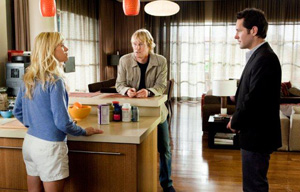
In most romantic comedies, there is one simple issue to be resolved: Will they or won’t they get together, and can the lovebirds overcome the fairly predictable obstacles to their climactic clinch? James L. Brooks’ How Do You Know is impressive first of all because there are so many other questions that enrich the romantic conundrum. The story begins when Lisa (Reese Witherspoon), who has devoted her whole life to sports, is cut from the USA softball team because she’s over the hill at 31. At the same time, George (Paul Rudd) learns that he’s under federal investigation because of shady dealings at the company founded by his father (Jack Nicholson). This study of two people cast adrift during a time of financial turmoil only gradually expands to incorporate a classic romantic triangle: Lisa is simultaneously dating George and Matty (Owen Wilson), a slick professional baseball player, while she navigates new professional terrain.
Brooks’ movies (Terms of Endearment, Broadcast News, As Good As It Gets) are often notable for their dense texture, and his latest comedy, though perhaps a cut below those three films, carries on that classy, literate tradition. Some critics have been griping, but How Do You Know boasts more depth—along with more robust laughs—than any of the other rom-coms in the marketplace lately. It’s funny, touching, deeply satisfying for sophisticated moviegoers in search of a break from the heavier fare that is usually on display during Oscar season.
What makes the film spin is that it has three expertly drawn characters, played by three of our most likable actors. Witherspoon is always a pleasure to watch, and she nails the toughness of a professional athlete while also highlighting Lisa’s befuddlement during a time of stress. Wilson plays a vain jock who seems at first glance like a caricature of the womanizing stud. Brooks and designer Jeannine Oppewall have fun with Matty’s bachelor pad, stocked with a drawer full of unused toothbrushes for his one-night stands and a closet that rivals those of the gals from Sex and the City. Yet Matty becomes more appealing as he finds himself falling for Lisa and decides to modify his hedonistic ways, though without inconveniencing himself too drastically. Wilson gives a light-fingered, high-flying comic performance.
George might have been an even more difficult character to bring to life. He’s an honest, decent man, and while many movies assert that their protagonist is a good person, few actually make a convincing case for the hero’s virtue. Brooks has invented a brilliant comic scene when George’s pregnant secretary Annie (a scene-stealing Kathryn Hahn) comes over to his apartment to disclose some inside information that could help him in his escalating legal troubles. George knows that Annie could lose her own job if she breaks her confidentiality agreement and reveals corporate secrets. Even though he needs the information that she possesses, George refuses to let her spill the beans; their byplay is comically inspired, but it also underscores George’s fundamental decency. Yet he’s never a plaster saint. Throughout the movie, Rudd gives the character human foibles that keep his virtue grounded and believable.
Nicholson could walk through the role of the venal, manipulative CEO, and one flaw of the movie is that he does just that, without finding the quirky human moments that the other actors highlight. Nevertheless, Nicholson participates in the movie’s funniest scene, when George and Lisa and George’s father visit Annie in the hospital after she’s given birth to the nearly 11-pound baby whom they name the Hulk. They are joined by the baby’s father, who decides to pick this moment to propose to the nearly comatose Annie. The series of comic epiphanies reminds you of Brooks’ roots in classic television comedy of the 70s, and yet the scene also tears at your heart by underscoring just how tortuous romantic commitment can be. The scene made me think of another moment from a classic romantic comedy, the scene in Woman of the Year when Katharine Hepburn attends the second marriage of her father and belatedly grasps what the marriage vows actually signify. Secondary characters play a role in the awakening of the movie’s protagonist, and that’s also what happens in the hospital scene in How Do You Know. It’s always a welcome treat to find unpredictable writing in a romantic movie. And that’s what makes Brooks’ latest movie a most engaging addition to an enduring but often desiccated genre.