





Conservatives (who aren’t doing so well lately—maybe you heard) often complain that Hollywood never makes movies that take religion seriously. Whether you’re a true believer or an atheist, you probably would have to agree with that assessment. The reason is not some nefarious leftwing conspiracy; it simply happens to be very difficult to make a film that deals thoughtfully—rather than mawkishly—with questions of faith and the supernatural. Yann Martel’s prize-winning novel, Life of Pi, did ponder the existence of God and the nature of religious belief. Now Ang Lee’s stunning film version of the novel becomes a rare movie with religious underpinnings that actually tantalize an intelligent viewer.
First and foremost, however, the film is an eye-popping 3-D spectacle. Most of the movie is an adventure at sea, featuring a boy, a tiger, and a few other assorted animals fighting an unlikely battle for survival in the middle of the ocean. Oscar-winning director Lee confirms here that he is one of the world’s major film artists. A couple of his earlier movies were misfires; I wasn’t impressed with his Civil War adventure, Ride with the Devil, or his last effort, Taking Woodstock. But most of his other movies—The Wedding Banquet,Eat Drink Man Woman, Sense and Sensibility, The Ice Storm, Crouching Tiger Hidden Dragon, and the groundbreaking Brokeback Mountain—enthralled me. What’s remarkable about this filmography is how varied it is. Lee belongs in the ranks of sometimes undervalued directors like George Stevens and Sidney Lumet who subordinated their own personality and mastered an astonishing array of film genres.
One can appreciate that the challenges of Life of Pi would have intrigued an ambitious filmmaker. For one thing, adapting an admired novel inevitably presents problems, and Lee and screenwriter David Magee have not solved all of them. They’ve added a clumsy framing device of our hero, Pi Patel, telling his life story to a writer, and that story takes a while to hit high gear. The childhood scenes of Pi and his family in India are charming, but a bit too leisurely. These flashback scenes are important in establishing Pi’s curiosity about religion, as he experiments with Hinduism, Christianity, and Islam in his search for answers to an often chaotic universe. And of course the family zoo will come to play a crucial role in the later sections of the story. But we grow impatient since there’s little dramatic tension in these tender vignettes.
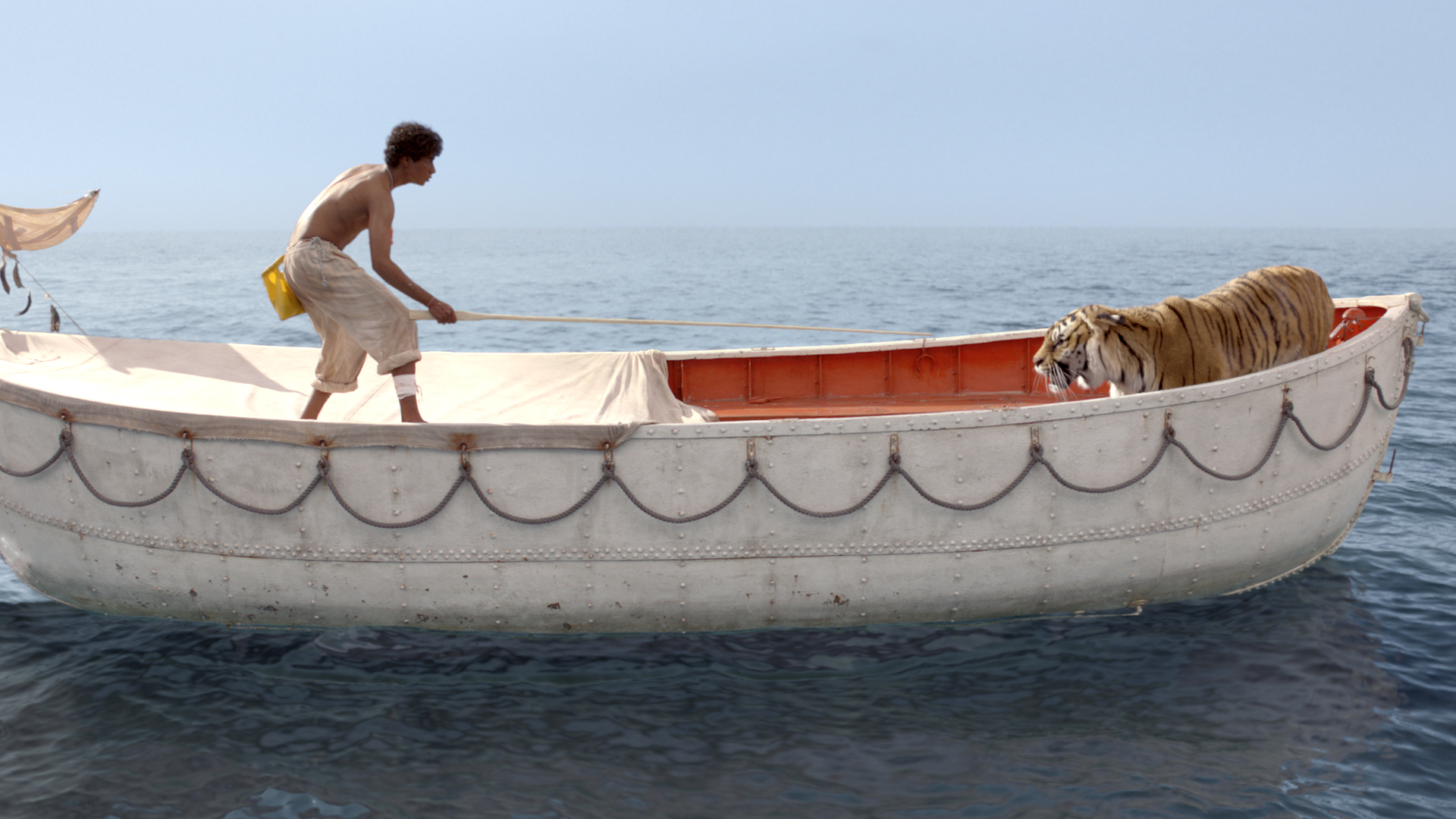
Once the family begins an ocean voyage from India to Canada, the film builds considerable intensity. The storm sequence that throws Pi (now played by newcomer Suraj Sharma) into a lifeboat in the Pacific is a bravura piece of filmmaking. But it is the kind of adventure scene we have seen in other movies. The scenes of Pi in the lifeboat with only a few animal companions represent something new in movies. Probably a full hour of the movie chronicles the adventures of Pi and a Bengal tiger (along with a few other four-legged companions) on the high seas, and Lee finds ingenious ways to keep this section of the movie alive. This is a rare film that makes solitude engrossing.
First of all, this represents pure movie magic because it leaves you wondering how Lee and his technical team created the illusion. The special effects that put Pi and the tiger in such close proximity are astonishingly lifelike and frightening. An attack of flying fish and a visit to a strange island populated entirely with meerkats evoke a bewitching fairy tale universe. The images dazzle the eye, but this sequence also depends on the performance of Sharma, who is extraordinary in his moments of fear, daring, and dejection. He makes you believe in Pi’s tenacious spirit.
There’s something more than pure animal instinct that helps Pi to endure this ordeal, and here is where the film’s deeper themes begin to emerge. Pi looks to God to aid his survival, but he faces despair when he realizes how many obstacles stand in his way. Somehow, however, he refuses to abandon his belief that providence and a sense of the miraculous may play a role in his ultimate rescue. When he finally does arrive on land, Pi answers questions from the authorities, who are skeptical about the adventure he recounts, especially since the tiger he describes has vanished. To oblige his interrogators, Pi eventually gives an alternate account that involves three other human survivors of the shipwreck in a much darker, more macabre story of survival as a brutal Darwinian adventure. This narrative is more credible to outsiders, but in the end, Pi asks which story we prefer—a nihilistic story of human savagery or a wondrous tale of inter-species communion. As a child, Pi questioned some of the Bible stories he was taught. His own journey reminds him that religion crafts myths in order to provide meaning, mystery, and hope. But are these fanciful stories less relevant than purely scientific accounts? The film allows us to answer that question for ourselves, so we never feel browbeaten by a religious agenda. But we feel moved to think about the possibility of cosmic design and to contemplate our place in an indifferent universe. Any film that inspires such questioning while also taking us on an unforgettable thrill ride deserves to be savored.